
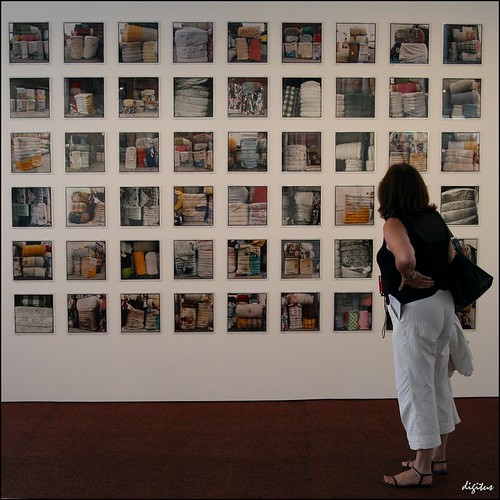


"Everything that is empty, banal and trivial is somehow transformed in her photographs into the extraordinary poetry of the representational world."
"In open mouth, teeth showing Leonard has designed a sort of "artistic thriller" a suggestive, spatial arrangement in whcih we see the unfolding of a contradictory mood of passivity and aggression."
“I am interested in making a record of an urban landscape as a way of looking at who we are as a people, who we are as a culture, understanding the city as a social space, … as an economic space”
“As we trade goods with other countries we also trade ideas and ideologies.” Zoe Leonard is interested in looking at “how we affect the landscape around us, what we build, what we leave behind, what we make.”
I look at her work and it seems that she does not create these situations. she goes out and finds them. I can particularly relate these to my 3 photos I placed together of called creative landscaping. its similar to me taking the photos of landscapes in morrisons then bringing them together. Her dolls create tension and signify to me the weirdness i found within the argos catalogues when I saw baby dolls dressed as brides etc. there is a sense of aggression because they are all facing the same way and I am guessing they are facing the viewer as they enter the room. Dolls actually cant stand upright, so she has found a way of making them stand up making us notice their height in relation to us in everyday life. these dolls are usualy on their backs. They stop the viewer from being able to pass through the room freely, these being pievces of art mean that they hold a certain preciousness stopping the viewer from kicking them over to get to the other side.
“My own neighborhood is filled with the signs of a local economy being replaced by a global one: small businesses being replaced by large corporations, multinationals taking over. The deeper I look, the more I realize that in looking into these shop windows, I am also looking out at the rest of the world. I think this is a unique moment to document, and an important one to archive. I know the world will never look quite this way again, and I feel that I want to look closely, to hold it near."
I find this quote very interesting. I am very anti supermarket even tho i partake in them because I am too busy to go anywhere else. I have no choice but 2 shop in these because I take work so seriousoy or am playing. I am very anti tesco in particular but i always try and use markets and i do watch local butchers etc being shut down and it deeply upsets me. i also want to make work about the changing aspects of urban culture. i want to document it. How things are changing over time.
Finding the right darkness - frieze article online.....
". Leonard’s installation Strange Fruit (1993–8) is dedicated to the memory of David Wojnarowicz. A sculptural work made of 295 unpreserved fruit peels, its guts would make a lovely citrus salad: grapefruit, orange, lemon, accented by banana and avocado. But these are just the peels: the residual effects of consumption. This is a strong theme in Leonard’s work. Forced open, by virtue of a thumb or a knife, the peels are emptied of their fruit, then hand-sewn back together into deflated shapes, embellished with bright yellow, white and red thread, zips, clasps and buttons. As well as its more obvious descriptive meanings, the title plays on the idea of ‘fruit’ as a euphemism for fag (as in sexual orientation, rather than cigarette) and a more general idea of persecution – it is surely no coincidence that ‘Strange Fruit’ is also the name of the anti-lynching ballad that Billie Holiday made so famous in the 1930s.
Strange Fruit happened to me at the Philadelphia Museum of Art, some time around 2000 or 2001. I say ‘happened’ because I was cranky with my companion, who insisted on sitting through 35 minutes of video art even though we had agreed to leave. Strange Fruit was something I had walked by, on the way out of the contemporary wing. From a distance it looked like detritus. Then I got closer and stopped being annoyed and instead became very sad and felt suddenly very alone – despair hit me like a truck. The sewn fruit was absurdly, inexplicably, intimate. When Leonard says, ‘The fruit is very, very silent’, I believe she means that it both comes from a place of absence and also creates one. It actually turned out I was alone. The museum showed the work without a guard in the room, so as not to detract from its intended private atmosphere.2
Leonard’s work bears this out; it asks not what things are, but rather what value they are assigned in the human economy.
Deadly ironic, Every Building … offers the most banal daytime views of the shopfronts along the strip, renowned for its glamour and nightlife, showcasing regular apartment and office buildings as well as shops that have seen better days. There are also no people in his photographs: no tanned, healthy Californian bodies, no celebrities utterly deflating the myth of Hollywood grandeur. Re-inscribing photography as a tool of the amateur, Ruscha pokes fun at the viewer’s expectation of the tourist snapshot, Hollywood as a lights-and-action, palm-tree-fringed paradise rather than a place that ordinary citizens inhabit.
At the same time, though, ‘Analogue’ is perhaps the most formal body of work that Leonard has completed: for all its individual images, it charts monotony purposefully, tracing out the recurrent patterns, colours and formulas frame by frame, to record the encroaching threat of sameness – which is a metaphor for loss. Her engagement with absence has spanned the duration of her career, but what began with the individual body, the body as a site of loss and mourning, became larger and larger, a meditation on the everyday losses, sustained locally, that cause deprivation and suffering elsewhere. In this way ‘Analogue’ evokes chaos theory, or at least the layperson’s understanding of it, where a butterfly flapping its wings causes a hurricane in another part of a world. "

No comments:
Post a Comment