



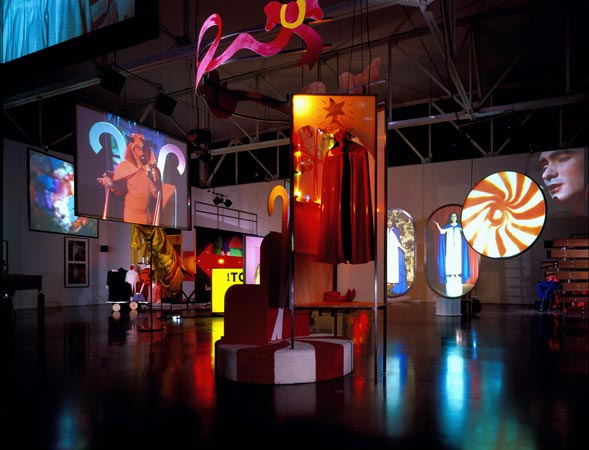
"Kelley’s work ranges from highly symbolic and ritualistic performance pieces, to arrangements of stuffed-animal sculptures, to wall-sized drawings, to multi-room installations that restage institutional environments (schools, offices, zoos), to extended collaborations with artists such as Paul McCarthy, Tony Oursler, and the band Sonic Youth.
His work questions the legitimacy of ‘normative’ values and systems of authority, and attacks the sanctity of cultural attitudes toward family, religion, sexuality, art history, and education. He also comments on and undermines the legitimacy of the concept of victim or trauma culture, which posits that almost all behavior results from some form of repressed abuse."
"KELLEY: "Day is Done" is built around the mythos that relates to "Educational Complex" and the history of a kind of symbolist attempt at uniting all the arts. "Educational Complex" is a model of every school I ever went to, plus the home I grew up in, with all the parts I can’t remember left blank. They’re all combined into a new kind of structure that looks like a kind of modernist building. I started to think about this structure through the Gesamtenswerk, the ‘total artwork’, of Rudolf Steiner, where he tries to combine all the arts and develop a kind of rule system according to which every art form is related. So the architectural relates to the dance relates to the music relates to the writing. But it’s also a kind of religion. And so my religion for this structure is repressed memory syndrome. The idea is that anything you can’t remember, that you forget or block out, is the byproduct of abuse and that all of these scenarios are supposed to be filling in the missing action in these blank sections in this building. It’s a perverse reading of [Hans Hoffman's] push-pull theory. "
ART:21: What is your source material for "Day is Done?"
KELLEY: All the scenarios for "Day is Done" are based on images found in high-school yearbooks in this particular case, though I’ve also done a whole collection of similar kinds of images from the small-town newspaper of the town where I grew up. The particular categories had religious ritual overtones, but outside of the church context. They all looked like they were done in public places, or they had gothic overtones. So I said, “Okay, I’m going to work with these particular groups of images and develop a kind of pseudo-narrative flow.” The rituals run the gamut from something like dress-up day at work to St. Patrick’s Day or Halloween, to a community play or an awards ceremony. So all I have is this image, and then I have to write a whole scenario for it like a play, and then do the music and everything. Each one is just based on the look of the photograph that tells me what style it has to be done in.
ART:21: How do you expect viewers to respond to this work?
KELLEY: I know that people don’t look at art like that, and I don’t expect people to know any of this stuff. And I don’t care if they do or don’t, because you have to make an artwork so it can be enjoyed on the most surface level, but I want for the more dedicated art viewer to be able to get the secondary and third levels of meaning. It has to operate on multiple levels: it has to be available to the laziest viewer on a certain level, and then on a more sophisticated level as well.
ART:21: Do you find this project humorous?
KELLEY: I think that’s the joyfulness of it. But then it’s a black humor, it’s a mean humor, so it’s a critical joy. You know, it’s negative joy. (LAUGHS) But that’s art I think—for me at least. That’s what separates it from the folk art that I’m going to. I think the social function of art is that kind of negative aesthetic, otherwise there’s no social function for it. You don’t need art then. Television can do the same thing.
I was more interested in the kind of popular material that they were working with, which was the lowest of the low, rather than New York pop art which tended to be more mainstream, like Warhol’s Campbell Soup cans and very standard Americana kind of imagery. I was more interested in that kind of ‘sub-stuff’.
ART:21: You’ve always been interested in Marxism...
KELLEY: Very much so, yes. Always, my interest in popular forms was not to glorify them—because I really dislike popular culture in most cases. I think it’s garbage, but that’s the culture I live in and that’s the culture people speak. I’m an avant-gardist. We’re living in the postmodern age, the death of the avant-garde. So all I can really do now is work with this dominant culture and flay it, rip it apart, reconfigure it, expose it. Because popular culture is really invisible. People are really visually illiterate. They learn to read in school, but they don’t learn to decode images. They’re not taught to look at films and recognize them as things that are put together. They see film as a kind of nature, like trees. They don’t say, “Oh yeah, somebody made that, somebody cut that.” They don’t think about visual things that way. So visual culture just surrounds them, but people are oblivious to it.
BROUGHT UP AS A CATHOLIC. RITUAL ART = MATERIAL RITUAL FOR HIM. HE ALSO WAS NEVER A BELIEVER....TO DEVELOP A MATERIALIST RITUAL.
STUFFED ANIMALS COMODITY CULTURE BUT PPL THOUGHT IT WAS CHILD ABUSE. NOT EXPECTED. THEY THOUGHT PERSONAL ABSUE. HE STARTED MAKING WORK ABOUT HIS ABUSE, ABOUT EVERYONES ABUSE, OUR SHARED CULTURE. THE PRESUMPTON THAT ALL MOTIVATION IS BASED ON REPRESSED TRUAMA. HE DOESNT REJECT RESPONSES, HE RUNS WITH THEM. IT TELLS HIM WHAT TO DO. WORKS WITH MANY DIFFERENT TROPES. MUSIC, PERFORMATIVE. SENSE ALWAYS COMES AFTER THE FACT IN HIS WORK. HAS TO OPERATE ON MANY LEVELS, HAS TO OPERTATE TO THE LAZIEST VIEWER, ON A CERTAIN LEVEAND THEN A MORE SOPHISICATED LEVEL AS WELL.
A REVIEW:
The installation of the Mike Kelley retrospective at the Whitney Museum of American Art is crowded. There’s too much to see, even for the repeat visitors, the fans, me. At the opening, a friend complained to me that the cram-in-as-much-as-you-can installation severely compromised the show. ‘the afghan piece with the bumps’ - Lumpenprole 1991 - ‘could be so beautiful, but all this other junk detracts from the image. It almost makes me think Mike Kelley isn’t as great an artist as I’d always thought he was.’
Another artist, a friend of mine and a fan of Kelley’s work, told me when i said I was having a hard time digesting the plenitude of Kelley’s retrospective, ‘It’s all about generating ideas, so many ideas going on when most artists stake entire careers on just one idea, repeated over and over again ad nauseam.’
There is little to be gained in inventing a new language when no-one can understand you; the innovations neccessarily come from within pre-established forms, even if the hidden agenda is the destruction of those very forms.

No comments:
Post a Comment