Thursday, 29 October 2009
Bibliography
Bowness A (1989) The condition of sucess - how the modern artist rises to fame, Thames and Hudson.

THE ART FAIRS 2009

I took the air fairs a little less seriously this year. I think this is due to spending so much time on the "business" side of things in the second year that I've set myself a rule to put most of my attention on the making etc.
At first the Affordable art fair felt nice. I felt like although the crap art was around, the people around me seemed nicer. I didn 't seem as elitist and I think this elitist topic is playing on my mind a lot. However towards the end of being at the fair I started to hate it. I got so sick of looking at paintings of flowers and fields. And the crowd started to annoy me. It reminded me of the art "the middle class people" would have above their fire place. It reminded of a comment my best friend made at home of her thinking that art isn't a job, she sees it as a hobby. Two types of fine art?
 The free art fair sounded like a nice concept. However the lay out annoyed me, I couldn't be bothered to go find it all. It's like I wanted it to be given to me on a plate. However I took the opportunity of the fair to meet up with people I made friends with in Zoo last year. I started to view this weekend of fairs as like a "happy new year" period for the art world. An excuse for everyone all over the country to come to one stop and catch up. I don't know whether this is the general use for artists with art fairs. Because art fairs certainly aren't for the artists.
 We were told by Tania to go to Frieze. I didn't go. I thought about it long and hard and I bought a ticket then sold it to someone else and went to a rave instead. I felt like this was a calculated dicision though. When Tania was talking to us I tried to ask questions that would really help my own practice. She explained her own process and how she's made a decision to not work in the gallery/dealer way. She said that when she had left uni she didn't have a clue how to work as an artist which has given me confidence in thinking and I kind of know how the system works so maybe the possibility of being able to be an artist alone is possible. She explained how markets worked etc and I said I could see myself at Zoo but not a Frieze. Is that because I'm at such an early stage in my work that Frieze seems so far away and Zoo seems more approachable? Or is it becuase I generally feel like art should be treated with more respect than it is in Frieze?
 Zoo was good. I found myself not even looking at the exhibitioned spaces. Its like my head was in "don't give a shit" mode. I saw a couple of pieces which affected me. But generally was just walking around because I felt like I had to. The atmosphere was so different compared to last year. I like this mobility and versatility, maybe even adaptability to an art organisation. This is why I will always go back to Zoo every year. The way they approach problem solving, the dynamic of the company and the people in it excites me. I guess I believe in this company. Alot. I think this ability to move,change, adapt is majorly important in a world which consumes and disposes so quickly. Companies and "things" need this characteristic to survive. Watching them change is an art in itself for me.
Saturday, 24 October 2009
Fischli and Weiss Book

 *A chapter made of questions written by the artists, complimented with the writers answers to them. The moral of the work was that there are so many questions with no or inacurate answers. Art is about asking questions.
 *Presented with a beautiful narrative piece about how he was first full of straw and wished for a more exciting life away from the mountains where he lived. One day a bank robber came and stole him, drove him down to the city where he stuffed him with money and left him in a cellar where he was too heavy to move and unhappy.
This reminds me so much of me wanting a better life for myself and going to "the city" to be an artist, being commercially successful, rich but not happy. It doesn't say whether the narrative was with the piece when exhibiting, but if it wasn't, it shows how much the publications to a piece can change the way viewers interact. I am only experiencing Fischli and Weiss from books, and how they are documented and portrayed play a massive role in how I am receiving them.*
 *I'm attracted to the throw away element in these pieces. The simplicity of a human being represented as a fag butt is beautiful. The situation in the photo itself is harlarious. It looks rediculous but it makes sense. you can imagine an actual car crash looking like this. This type of work requires such a high level of sensitivity, and acute observation. *
* I find myself thinking along the same lines as the Agnes Dene's piece when I look at this; in terms that when she documented her final piece, it wasn't obvious enough so she added her drawing. To me the photo of the piece is the piece of work. If it was the sausages themselves I don't think it would be as powerful. The angle of the shots is just as important as the sausages themselves. I lack this in my work. The ability to decide how best to present something for what I want it to say.*

 *My favourite piece out of the whole book, strangely the once I have least to write about for now*
 Henrik Håkansson - Fallen Forrest.
  *When a person views a landscape they see it horizontal with the frame of their eyes as a viewpoint. Fischli and Weiss's works enable us to experience landscape from a different viewpoint, looking down. This concept also came up when I viewed a piece at the Barbican by Henrik Håkansson - Fallen Forrest.
  * When reading about these first I didn't quite understand what it was about, but after reading about their garden and landscapes photography I began to understand them. They create things which are so close to actual reality that it's almost a question of whether it is art, but it is. These airport photos aren't searching for anything more than what they are. The garden was literally just a garden they had created, so what is it about them that makes them art? It reminds me of when you imagine situations in your head, for a future scenario; for it to be perfect, spot lights on you, like in a film trailer, but when these events come round, they just end up no where near your expectations and reality is never how you imagine it will be.
Creating these photos and situations are art because it's purpose is it be art. A viewer would never be allowed to just walk into an allotment and if they did, they still wouldn't look it with the act of looking. Creating these art things makes us really look at the situations around us in more detail.*
The Serpentine Gallery - Gustav Metzger: Decades 1959–2009
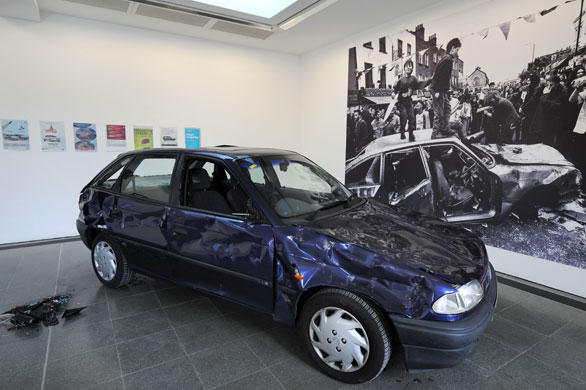
*This piece took a while to sink in. It wasn't till the loop of the child talking that I started to break the piece down more. It's a political statement, but I don't understand it. Maybe as time progresses it'll make more sense.*

*The conceptual element in this piece gives the artist the control over what the piece is, the themes were laid out as to what topics the viewer could choose from the current papers. It gives the viewer an element of control as they pick the actual pages displayed on the wall to create the conversation. One was "What it is like to live in today" which allows the viewer to respond on a very personal level. It creates an environment which makes people feel like they have control when actually it's very minimal which reflects the current state of democracy *
 *These pieces were very interactive. I participated with the piece up on the wall but I didn't have the courage to do the one on the floor. It was mostly children that got into the piece, and adults would watch and smile. There was a very weird atmosphere in the room from these pieces. All the viewers could feel it, we all felt like a different sensory experience was expected in order to understand the piece, but were people ready to get down on the their hands and knees? A different level of interaction. When in the wall piece, was viewing with a stranger but felt very intimate, like we were sharing an experience together. However couldn't work the image out. I struggled to break the piece down but when leaving the show I heard a father say to his child "what does it mean?" when the son said he didn't know the father replied "In order to see an image for what it is sometimes we need space from it".*
 *Second time I have viewed this work. Very hypnotic. The size of the screens encapsulated the viewer. I was more interested in the technique of how this was created. Was asking question about how the projectors were programmed into working together. I associate this work a lot which escapism. It is something to occupy you for however long you want to look at it, a little like my string pieces. I'm struggling to break this piece down though.
This ability to create a discussion about current affairs is something I want to potray in my work. I don't want to be a political artist but I believe it's an artists responsibility to create discussions about the current world
The Barbican Art Gallery - Radical Nature
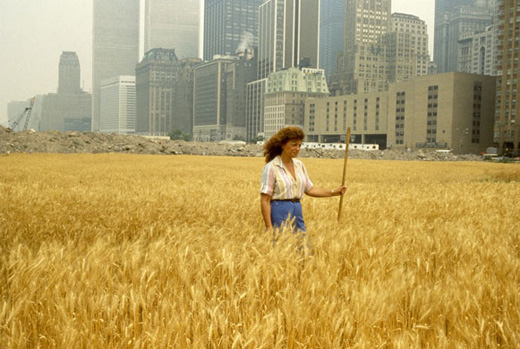
Agnes Dene – Wheatfield – A Confrontation, 1982
*When looking at another piece of hers, I realized she had presented her documentation of the landscape work with the original drawing to propose it. The finalized piece wasn't the best way to describe her concept so her decision to exhibit it with the inital drawing clarified her idea to the viewer. - I need to learn how to clarify my conversation with the viewer.*

Newton Harrison and Helen Mayer Harrison - Full Farm, 1972
*When reading the reviews for this show, this piece was questioned on whether it was art. I have been researching on the museums and galleries job to pick out processes or objects of major significance within society which seem to be dieing out and this piece, although very obvious triggered thoughts. I began thinking about the role of the supermarket and how the relationship between humans and food has changed. For this I would say that it was the most successful piece of work for me in the exhibition just because it allowed to analyze a topic which was fresh in my mind at the time.*
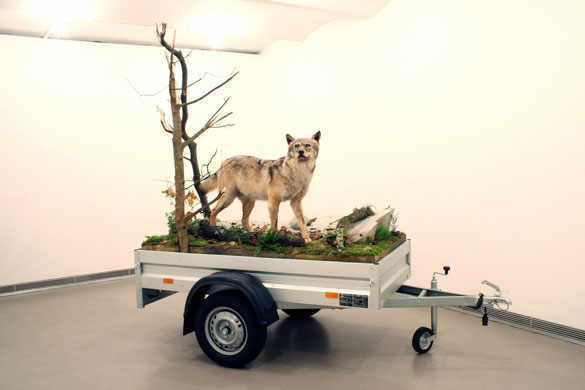
Mark Dion – Mobile Wilderness Unit – Wolf, 2006
*Experiencing a wolf?* Nature used as commodity? I Heart this piece! - Further research into Mark Dion
Subscribe to:
Comments (Atom)